Is your SEO agency covering you for AI Search?
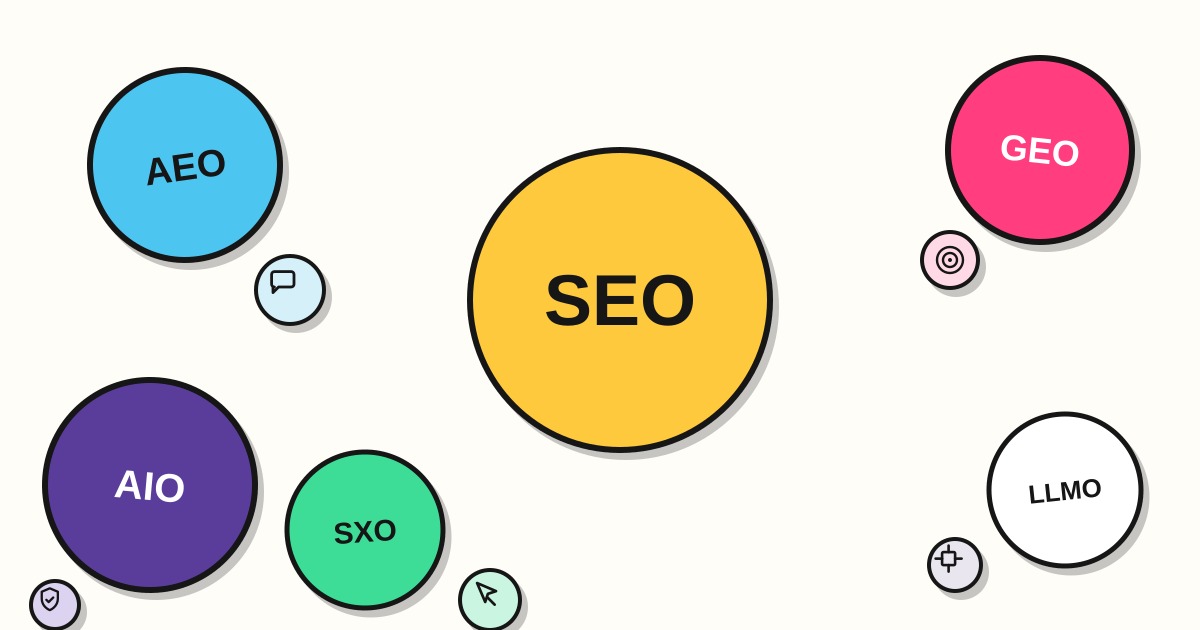

SEO is still the foundation. Here’s where AEO, GEO and AIO fit in.
New acronyms have started showing up in marketing conversations lately: AEO, GEO, AIO. And maybe you’re starting to wonder if your dental practice is AI-friendly, or if your SEO strategy is built for ChatGPT.
Do you still need SEO? Do you need AEO, GEO, AIO too? Has your current dental marketing agency already got you covered for AI search?
Here’s our honest answer.
So, is it still SEO?
That’s a question we get asked a lot. The acronyms tend to show up in a proposal, a marketing newsletter, or social media posts. The real question though isn’t what is AEO or GEO?. The question is: is SEO already enough, or do I need to pay for AEO, GEO and AIO on top?
Here’s the short version: you should probably already be covered. AEO, GEO and AIO aren’t a new category of marketing spend. They’re new names for places people now look for answers, sitting on top of the same SEO work that’s always mattered. If your dental agency is doing SEO properly, they’re doing most of this already.
Continue reading to learn what each acronym actually means, what’s changed in AI Search, and what that means for whether your dental practice shows up in AI results.
The decoder: what do SEO, AEO, GEO and AIO actually mean?
None of them replace SEO and they’re all built on top of it:
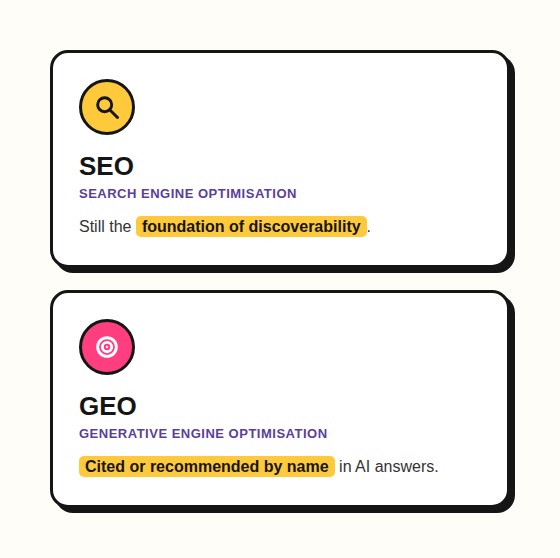
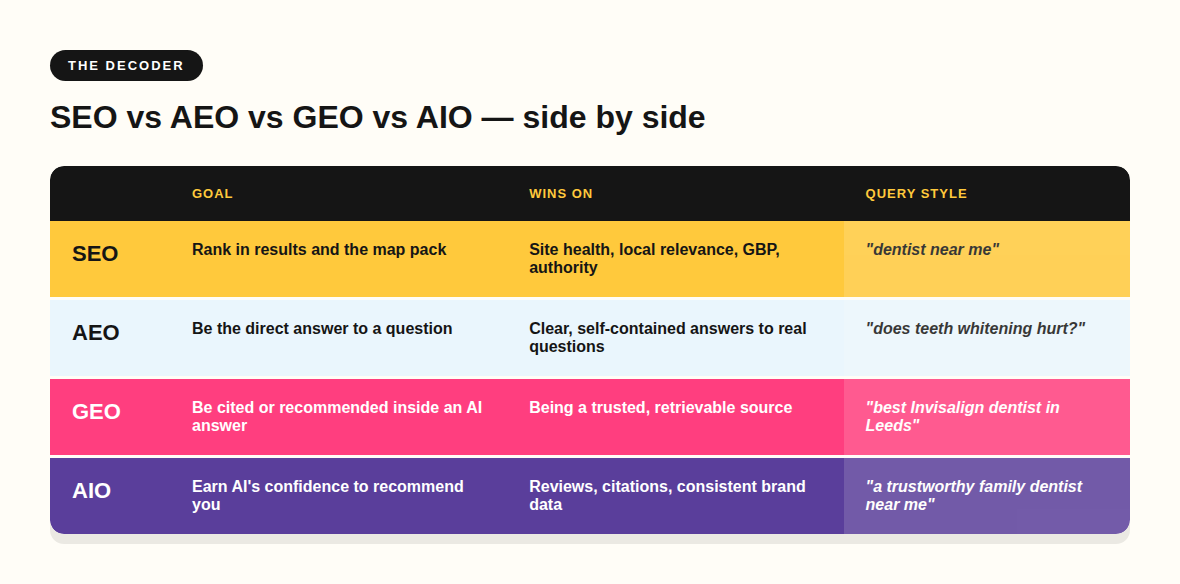
- SEO (Search Engine Optimisation) is still the foundation of discoverability.
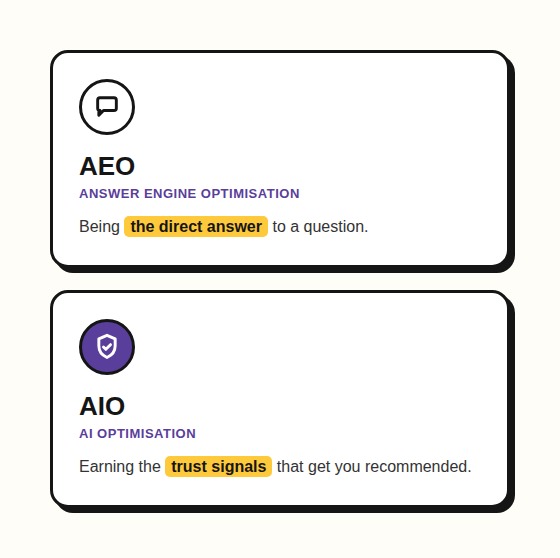
- AEO (Answer Engine Optimisation) is about structuring content so it becomes the direct answer in featured snippets, “People also ask,” voice search, AI answer boxes.
- GEO (Generative Engine Optimisation) is getting your dental practice cited or recommended by name inside AI-generated answers from tools like ChatGPT, Google AI Overviews, Gemini, and Perplexity. This is about being included in the sources these tools cite, not about ranking on a page.
- AIO (AI Optimisation) is about building the off-site trust signals (reviews, citations, brand mentions) that make AI systems confident enough to recommend your practice by name. This is the reputation layer: it’s earned outside your own website, not written on it. We go deeper on this in Why trust is the new SEO currency for dental practices.
SEO vs AEO vs GEO vs AIO
A quick history lesson: hasn’t SEO is dead been said before?
Yes, many times. It’s one of the oldest headlines in digital marketing. It was first declared in 1997, the same year the term SEO was first used. It came back in 2005, 2010, 2011, 2012, 2015, and 2022, each time riding a new Google update or a new platform. Now it’s back again, this time because of AI Overviews and ChatGPT.
The pattern is always the same: an algorithm update, a new interface, a new platform… and someone mistakes a tactic that stopped working for the discipline dying altogether. It never has.
So no, SEO is not dead. It’s evolving, and that evolution is exactly where AEO, GEO and AIO come from.
The real shift: from ranking to being recommended
Traditional search is a ranking game: your dental practice competes for a high position on Google’s results page. What does success look like? A high ranking turns into a website click, a click into website traffic, and that traffic turns into new dental patients.
AI search plays a different game. A single patient question can be broken down by the AI into a dozen or more related searches behind the scenes before it gives one answer, so you’re no longer just competing for a position on a page, you’re competing for inclusion in that answer. Success is that your dental practice is being cited or mentioned, even if no one ever clicks through to your website.
Ranked. Cited. Recommended. That’s the shift, and it’s the reason all these new acronyms exist. They’re not new competitors to SEO. They’re describing different places people now look for answers. We’ve written before about why it’s not just about ranking #1 on Google anymore. This is the same idea, just applied specifically to AI.
A reality check: does AI search actually send you patients?
Not yet.
Data from Similarweb shows that AI-platform referral traffic is just less than 1% of total website traffic, even for websites AI tools cite constantly. Being cited and being clicked turn out to be two very different things.
However, most AI citations still come from pages that already do well on Google. Ahrefs’ most recent large-scale study found 38% of AI Overview citations came from the top 10 Google results, and around 69% from somewhere in the top 100, down from 76% and 86% respectively just seven months earlier. So this isn’t a brand new game with a brand new set of winners, but the correlation with traditional rankings is getting weaker, not stronger, which is worth watching.
For a dental practice specifically: bookings still overwhelmingly start with your Google Business Profile and local search, not AI. Being named by an AI tool is a brand-awareness win, not a lead-generation channel, at least for now.
Do you still need SEO to appear in AI results?
Yes. Google confirmed in its May 2026 AI optimisation guide that AI Overviews and AI Mode run on the same core search ranking systems, not a separate one. If your practice isn’t visible in regular Google search, it won’t appear in AI results either.
Read our full breakdown on this topic: Why is my dental practice not appearing in AI results?
The bottom line
SEO isn’t dying. It’s not even really changing shape that much, it’s just being asked to work across more surfaces than it used to: the search results page, the AI answer box, the voice assistant, the chat window.
At MiSmile Media, when we build an SEO strategy for your dental practice, AI visibility isn’t a separate add-on, it’s already built in, because the two are the same foundation. If you’re not showing up in search results, you’re very unlikely to be showing up in AI results either.